
 Posts
Posts


A dead jellyfish can still sting. Pictured on the left is a box jellyfish, also known as a sea wasp and a marine stinger. It is considered to be the world's most venomous creature. Those who survive a box jellyfish stinging will likely have severe pain lasting for weeks. Unlike other jellyfish the box jellyfish can move and has multiple eyes. However, it has no central nervous system. So, scientists don't yet know how it processes what it sees. [Source: http://animals.nationalgeographic.com/animals/invertebrates/box-jellyfish.html,et al]
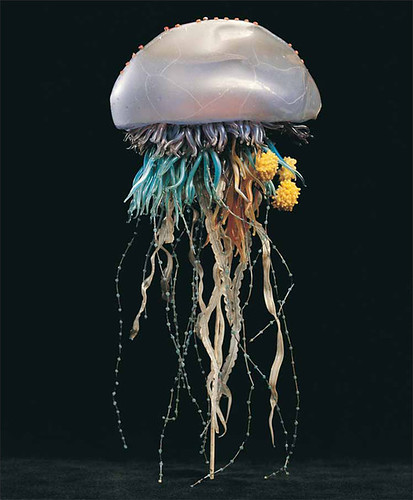
Pictured above is a Portuguese man-of-war, so named because of its resemblance to a Portuguese warship that sailed centuries ago. It is also known as a "bluebottle" because of its blue-purple color and is commonly mistaken for a jellyfish. However, it belongs to a separate family of organisms known as siphonophores, creatures comprised of collaborative colonies of distinct organisms. It consists of four main polyps classified as zooids. Zooids are organisms with specialized functions that cannot survive separate from other zooids. One zooid is the gas-filled bladder (pneumatophore) with the warship resemblance. It makes the colony float and can deflate for submersion to allow the creature to escape danger above the surface. The dactylozooids are the clusters of zooids that form the tentacles with stinging cells for paralyzing and killing fish and other prey. These tentacles can dangle 165 feet below the surface. Muscles in the tentacles deliver captured prey to the gastrozooids (digestive organisms). The gonozooids are the reproductive organisms. Like a jellyfish a dead Portuguese man-of-war can still sting. The venom in the stinging cells is nearly as potent as a cobra's but human fatalities from Portuguese man-of-war stings are rare because the microscopic stinging cells secrete insufficient venom to kill humans. The rare human fatalities have resulted from severe systemic reactions to the venom. [Source: http://www.dnr.sc.gov/marine/sertc/The%20Portuguese%20man.pdf, http://animals.nationalgeographic.com/animals/invertebrates/portuguese-man-of-war.html, et al]


No comments:
Post a Comment